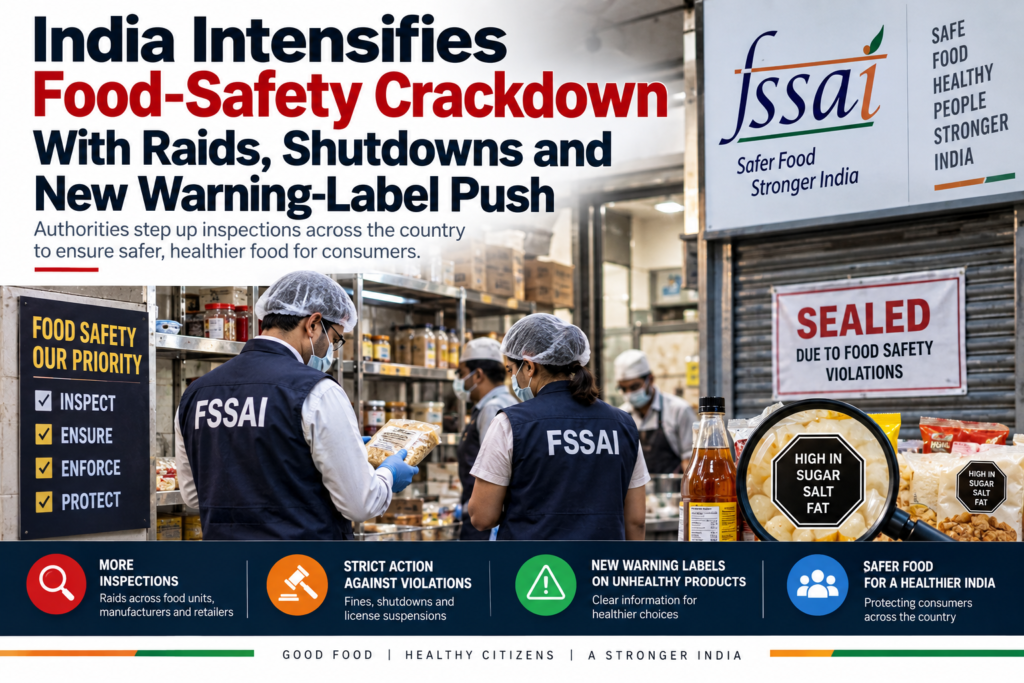
India has intensified its food-safety crackdown, with regulators carrying out raids, shutting down non-compliant food businesses, cancelling licences and seizing large quantities of allegedly unsafe or adulterated food.
At the same time, the Food Safety and Standards Authority of India (FSSAI) is moving ahead with a proposal for prominent warning labels on packaged foods that contain high levels of sugar, salt and saturated fat.
The combined enforcement and labelling push represents one of the strongest recent attempts to improve food standards in India and increase transparency for consumers.
Food-Safety Raids Expand Across India
Food-safety authorities have stepped up inspections across restaurants, food-processing facilities, warehouses, hotels, quick-commerce operations and other businesses.
Recent enforcement drives have uncovered a range of alleged violations, including:
- Poor kitchen hygiene
- Expired food products
- Incorrect or misleading labels
- Improper food storage
- Reuse of cooking oil
- Adulterated ingredients
- Unlicensed products
- Unsafe manufacturing practices
The crackdown is no longer limited to small roadside vendors.
Large restaurants, hotels, packaged-food companies and modern delivery warehouses are also facing increased scrutiny.
Thousands of Food Licences Face Action
Authorities have cancelled or suspended thousands of food-business licences as part of stricter enforcement of safety rules.
Regulators are increasingly using licence suspension, closure orders and financial penalties instead of relying only on warnings.
This reflects a broader change in enforcement strategy.
Rather than simply collecting samples and issuing notices, state authorities are moving toward immediate action when serious health or hygiene violations are identified.
Karnataka Steps Up Inspections
Karnataka has emerged as one of the most active states in the latest food-safety drive.
Officials have inspected hotels, paying guest accommodations, restaurants and quick-commerce warehouses.
In Bengaluru, authorities recently inspected dozens of PG accommodations and issued notices after discovering expired food, unhygienic kitchens and misbranded products.
One dining facility was sealed after inspectors found serious hygiene concerns.
Authorities have also sealed warehouse and canteen facilities following inspections that allegedly found problems with food handling, storage and labelling.
Major Food Seizure in Ajmer
One of the most striking recent cases came from Ajmer.
FSSAI officials inspected a food-processing facility and allegedly found broken noodles collected from the floor being reused to manufacture bhujia.
Authorities also reported unlicensed food products and hygiene violations.
More than 32,000 kilograms of stock were seized during the action.
The incident attracted significant attention because it highlighted the risks that can arise when food-manufacturing processes are not properly monitored.
Gujarat Seizes More Than 42 Tonnes of Allegedly Adulterated Food
Gujarat has also intensified food-safety enforcement.
State officials reported seizing approximately 42.9 tonnes of allegedly adulterated food products during August.
The seized products included items such as oil, ghee, milk and chilli powder.
Authorities inspected more than 2,000 food establishments, issued hundreds of improvement notices and cancelled dozens of licences following serious violations.
Crackdown Expands in Uttar Pradesh
Uttar Pradesh has also increased inspections, particularly around dairy products and sweets.
Recent inspections reportedly found suspected adulterants including detergent, refined oil, talcum powder and hydrogen peroxide being used in some dairy-processing operations.
Authorities have instructed officials to take action not only against individual shops but also against manufacturing and storage units connected to unsafe products.
This is particularly important during festival periods, when demand for milk products, khoya, sweets and other perishable foods increases sharply.
Restaurants and Branded Chains Under Scrutiny
Food-safety enforcement is also moving into organised restaurant chains.
Recent raids in Haryana reportedly found issues including insects in vegetables, fungus on bread and concerns about reused cooking oil at several establishments.
These inspections followed consumer complaints and raised questions about food-safety standards even at well-known brands.
The message from regulators is increasingly clear: food-safety rules apply equally to small businesses and major brands.
India Plans New Warning Labels on Packaged Food
Alongside raids and inspections, India is considering one of its most significant changes to packaged-food labelling.
FSSAI has proposed front-of-pack warning labels designed to alert consumers when products contain high levels of:
- Added sugar
- Salt
- Saturated fat
The labels are expected to appear prominently on the front of food packaging.
The goal is to help consumers quickly identify potentially less-healthy products without having to study detailed nutritional tables.
The proposal could affect a large portion of India’s roughly $100 billion packaged-food market.
Why Warning Labels Matter
India is facing increasing concerns about obesity, diabetes, heart disease and other lifestyle-related health problems.
Packaged foods that contain large amounts of sugar, salt or saturated fat can contribute to these risks when consumed frequently.
Front-of-pack labels are intended to make nutritional information easier to understand.
Instead of reading small-print ingredient lists, consumers could immediately see whether a product exceeds certain nutritional thresholds.
Similar systems have already been introduced in several countries.
Debate Over the Proposed Labelling Rules
The warning-label proposal has created disagreement between the food industry and public-health organisations.
Food companies argue that some proposed limits could be too strict and could result in warning labels appearing on a large number of packaged products.
Health activists, however, argue that the rules may actually be too lenient.
Under the current proposal, a warning may be required only when at least two of three nutrients — sugar, salt and saturated fat — exceed specified limits.
Public-health groups say this could allow a product extremely high in one unhealthy nutrient to avoid receiving a warning label.
Supreme Court to Examine Food Warning Proposal
The issue is now moving into the courts.
India’s Supreme Court is expected to consider concerns surrounding the proposed warning-label system on September 10, 2026.
Health activists have challenged aspects of the proposal, arguing that stronger consumer protections are needed.
The court’s review could influence how quickly the system is introduced and whether the nutritional thresholds are changed.
Packaged Food Industry Faces Major Changes
Any mandatory warning-label system could significantly change how packaged-food companies operate in India.
Companies may need to redesign packaging, reformulate products or reduce sugar, salt and saturated fat levels.
Products carrying prominent warning symbols could also face lower consumer demand.
This creates a strong commercial incentive for food manufacturers to develop healthier formulations.
Food Safety Becomes a Consumer Issue
The recent enforcement drive is also changing public awareness.
Consumers are increasingly sharing videos, photographs and complaints about hygiene conditions, expired products and misleading food claims.
Social media has made it easier for individual incidents to attract national attention.
In many cases, complaints from customers have triggered official inspections.
This means food businesses face pressure not only from regulators but also from increasingly informed consumers.
Quick-Commerce Warehouses Under the Scanner
India’s rapid growth in quick-commerce delivery has created new food-safety challenges.
Warehouses storing thousands of food products must maintain proper temperature, hygiene and storage conditions.
Recent inspections have found alleged violations related to handling, labelling and sanitation.
As rapid grocery delivery expands across Indian cities, regulators are likely to increase oversight of these facilities.
Why Stronger Enforcement Is Needed
India has one of the world’s largest and most diverse food markets.
Millions of food businesses operate across manufacturing, distribution, restaurants, retail and street food.
This makes enforcement extremely complex.
Reuters reported that around 20% of tested food products have failed standards since 2020, underscoring the scale of the challenge facing regulators.
Improving food safety therefore requires more than occasional raids.
It requires regular inspections, stronger laboratories, better monitoring and consistent penalties.
Impact on Restaurants and Food Manufacturers
The stricter regulatory environment means food businesses will need to invest more heavily in compliance.
Companies may need stronger systems for:
- Ingredient sourcing
- Storage temperatures
- Expiry-date monitoring
- Kitchen hygiene
- Food testing
- Employee training
- Packaging accuracy
- Nutritional labelling
- Record keeping
Businesses that fail to meet standards could increasingly face suspension or closure instead of minor penalties.
What Consumers Can Do
Consumers can also play a role in improving food safety.
Before buying packaged food, shoppers should check expiry dates, packaging condition and FSSAI licence information.
For restaurant food, customers should pay attention to hygiene and report serious violations to local food-safety authorities.
Once front-of-pack warnings are introduced, consumers may also have a simpler way to compare nutritional quality between packaged products.
What Happens Next?
India’s food-safety campaign is likely to remain active.
More surprise inspections, seizures and licence actions can be expected as state governments strengthen enforcement.
The Supreme Court hearing on warning labels will also be closely watched by food companies, health groups and consumers.
The outcome could influence the future of packaged-food regulation in India.
Conclusion
India’s expanding food-safety crackdown marks a significant change in how authorities are dealing with unsafe food practices.
Raids, seizures, licence cancellations and shutdowns are becoming more common across restaurants, hotels, manufacturing units and modern food-delivery warehouses.
At the same time, the proposed warning-label system could fundamentally change how packaged foods are marketed to Indian consumers.
Together, stricter enforcement and clearer nutritional information could create stronger incentives for businesses to improve food quality.
For India’s rapidly expanding food industry, compliance with safety and labelling standards is increasingly becoming not just a regulatory requirement, but a critical part of maintaining consumer trust.