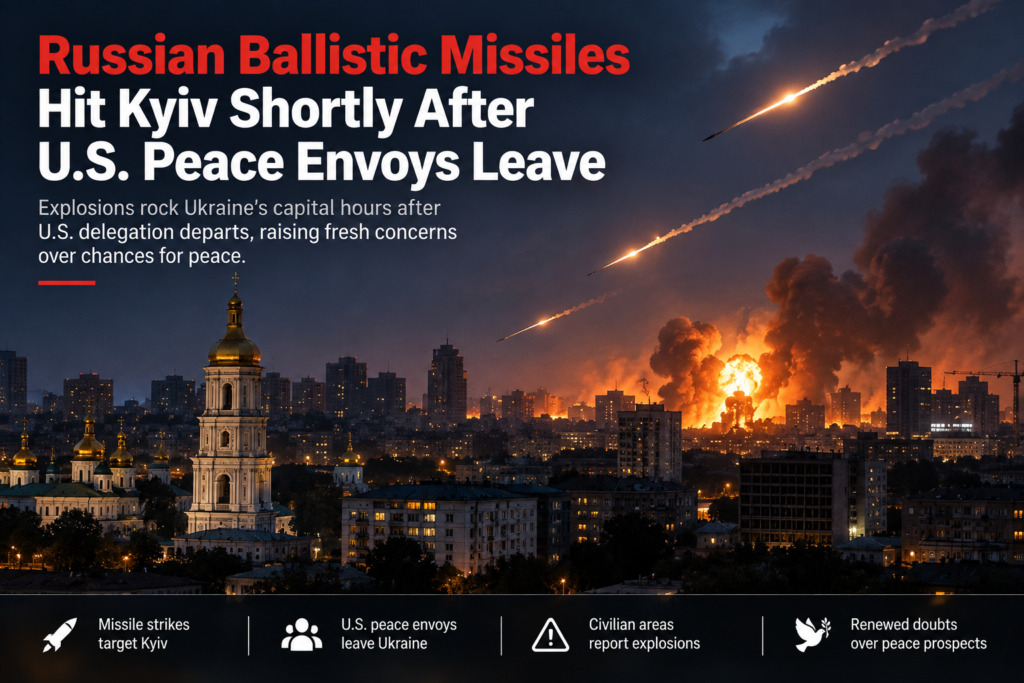
Russia launched a fresh wave of ballistic missile and drone attacks on Kyiv early Tuesday, ending a brief pause in strikes that had coincided with renewed diplomatic efforts by the United States to bring Russia and Ukraine back to peace negotiations.
The attacks came shortly after U.S. peace envoys Steve Witkoff and Jared Kushner departed Ukraine, where they had held discussions with President Volodymyr Zelensky and other officials.
At least two people were killed and around 10 others injured as explosions struck several districts of the Ukrainian capital, according to Ukrainian officials.
The timing of the attack has placed renewed attention on the fragile diplomatic effort to end a war that has continued for more than four years.
Russia Resumes Missile Strikes on Kyiv
Air raid warnings sounded across Kyiv during the early hours as Russian forces launched ballistic missiles and drones toward the Ukrainian capital.
Explosions were reported across several districts as Ukrainian air defence systems attempted to intercept incoming weapons.
Emergency services reported fires and damage to residential buildings and other civilian infrastructure.
The strikes marked the end of a temporary pause in major attacks on Kyiv that had accompanied the visit of senior U.S. officials.
The renewed bombardment demonstrated how quickly battlefield conditions can change even while diplomatic negotiations continue.
Two Killed and Several Injured in Kyiv Attack
Ukrainian authorities said at least two people were killed during the latest Russian assault.
Around 10 others were injured.
Damage was reported across several areas of Kyiv, including residential buildings, warehouses and other infrastructure.
Emergency crews were deployed across the city to extinguish fires, rescue residents and inspect damaged buildings.
Ukrainian officials said multiple civilian sites were affected during the attack.
The scale of the damage once again highlighted the continuing danger facing residents of the capital despite Kyiv being located hundreds of kilometres from the main front lines.
U.S. Peace Envoys Had Just Visited Kyiv
The Russian strikes came shortly after U.S. envoys Steve Witkoff and Jared Kushner completed a diplomatic visit to Kyiv.
Their trip formed part of Washington’s latest attempt to revive negotiations aimed at ending the Russia-Ukraine war.
Before visiting Ukraine, the American delegation had travelled to Moscow for discussions with Russian President Vladimir Putin.
The U.S. officials later met Ukrainian President Volodymyr Zelensky in Kyiv.
During their discussions, the sides explored the possibility of restarting a trilateral negotiating format involving Russia, Ukraine and the United States.
Temporary Pause in Russian Strikes Ends
Russian President Vladimir Putin had previously ordered a temporary pause in strikes on Kyiv while the diplomatic visits were taking place.
The pause provided residents of the Ukrainian capital with a brief break from increasingly frequent missile and drone attacks.
But that calm ended quickly.
Within hours of the departure of the U.S. delegation, explosions were again reported across the city.
The rapid return of military operations has raised fresh questions about whether diplomatic negotiations can produce a lasting ceasefire.
Zelensky Government Condemns Attack
Ukrainian officials strongly criticised the renewed strikes.
Foreign Minister Andrii Sybiha argued that the timing of the attack showed a significant gap between Russia’s diplomatic statements and its actions on the battlefield.
Ukraine has repeatedly called on Western countries to increase supplies of air-defence systems and interceptor missiles.
Kyiv says stronger air defences are essential as Russia expands its use of ballistic missiles and increasingly sophisticated drones.
Ukraine Faces Shortage of Air-Defence Interceptors
Ukraine’s ability to protect major cities remains heavily dependent on advanced Western air-defence systems.
Patriot missile systems supplied by the United States and European allies have played an important role in intercepting Russian ballistic missiles.
However, Ukraine has warned that interceptor missile supplies remain limited.
This has become increasingly important as Russia continues launching large numbers of drones and missiles in coordinated attacks.
Ukrainian officials have repeatedly urged Western governments to accelerate deliveries of additional air-defence ammunition.
Civilian Infrastructure Damaged Across Kyiv
The September 8 attack affected several districts of the Ukrainian capital.
Ukraine’s emergency services reported fires and damage at residential buildings and civilian infrastructure.
According to authorities, damage was recorded at numerous sites across Kyiv.
Emergency responders rescued residents trapped inside damaged buildings while firefighters worked to control several fires.
Such attacks can also cause indirect damage to electricity networks, transportation systems and other essential infrastructure.
Russia Says Military Infrastructure Was Targeted
Russia has repeatedly said that its strikes in Ukraine target military facilities, logistics infrastructure and sites supporting Ukrainian armed forces.
Moscow made similar claims following the latest attack.
Ukraine, however, reported significant damage to residential areas and civilian infrastructure.
Claims made by both sides during wartime are often difficult to independently verify immediately.
Peace Talks Remain Uncertain
The latest strikes have created renewed uncertainty surrounding U.S.-led efforts to restart negotiations.
Washington has been trying to bring Russian and Ukrainian officials back into direct talks after earlier diplomatic initiatives stalled.
The Kremlin said this week that it does not rule out restarting trilateral negotiations involving Russia, Ukraine and the United States.
However, Russian officials have also said that discussions about the timing and location of any future meeting remain premature.
Major Issues Still Separate Russia and Ukraine
Even if negotiations resume, major disagreements remain.
Territory is one of the most difficult issues.
Russia continues to control significant areas of eastern and southern Ukraine and has claimed several Ukrainian regions as part of Russia.
Ukraine rejects those claims and insists that any peace agreement must protect its sovereignty and long-term security.
Another major issue concerns security guarantees.
Kyiv wants binding guarantees from the United States and European partners to prevent another future Russian invasion.
Russia-Ukraine War Increasingly Driven by Drones
The battlefield has changed significantly since Russia launched its full-scale invasion in February 2022.
Both Russia and Ukraine now rely heavily on drones.
Small battlefield drones are used for surveillance and attacks against soldiers and vehicles.
Long-range drones are increasingly used to strike targets hundreds of kilometres behind enemy lines.
Russia has also deployed faster and more sophisticated drones designed to make interception more difficult.
Ukraine has similarly expanded long-range drone attacks against Russian military and energy infrastructure.
Poland Activates Air Defences
The latest Russian attacks also prompted neighbouring Poland to take precautionary measures.
Poland, a NATO member, has repeatedly activated military aircraft and air-defence systems during major Russian attacks on western Ukraine.
The latest wave of strikes again triggered defensive preparations.
Such responses highlight how the conflict continues to have security consequences beyond Ukraine’s borders.
Why Kyiv Remains an Important Target
Kyiv holds enormous strategic and political importance.
It is Ukraine’s capital, home to the country’s political leadership, military command structures and major infrastructure.
Russian attacks on Kyiv therefore carry both military and psychological significance.
Repeated attacks can disrupt daily life, damage infrastructure and force millions of residents to spend nights inside shelters.
At the same time, Ukraine has significantly strengthened air defences around the capital since the beginning of the war.
What Happens Next?
Attention will now turn to whether U.S. diplomatic efforts can continue despite the renewed violence.
Washington is expected to remain engaged with both Moscow and Kyiv as it seeks a framework capable of bringing the two sides back to negotiations.
But the latest missile strikes demonstrate the enormous challenge facing negotiators.
As long as major military operations continue, achieving even a temporary ceasefire will remain difficult.
The situation may ultimately depend on whether Russia and Ukraine can reach compromises on territory, security guarantees and the future structure of any peace agreement.
Conclusion
Russia’s renewed ballistic missile and drone strikes on Kyiv on September 8, 2026 have underlined the fragile state of diplomatic efforts to end the Ukraine war.
The assault killed at least two people and injured several others shortly after U.S. envoys Steve Witkoff and Jared Kushner completed a diplomatic visit aimed at restarting peace negotiations.
Although Washington continues to push for talks involving Russia and Ukraine, the rapid return of missile attacks demonstrates the deep divisions that remain.
For residents of Kyiv, the latest explosions were another reminder that diplomacy and warfare are continuing simultaneously — and that a lasting peace agreement remains far from guaranteed.