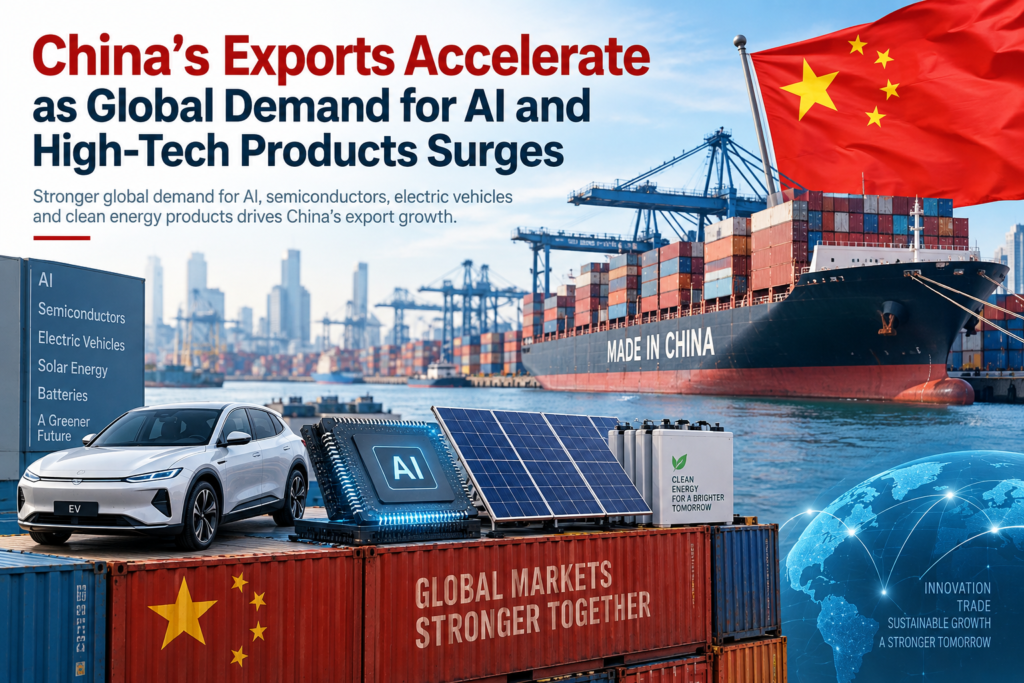
China’s export growth accelerated strongly in August 2026, supported by rising global demand for artificial intelligence technology, semiconductors, electric vehicles and other high-tech products.
Fresh customs data showed that Chinese exports increased 25% year-on-year in August, compared with 23.9% growth in July. The latest figures highlight the growing importance of technology-related goods to China’s international trade and wider economy.
The strong performance comes as businesses around the world continue to invest heavily in AI infrastructure, data centres, computing equipment and advanced electronics.
China Exports Rise 25% in August 2026
China recorded another month of impressive export growth in August.
Exports expanded by 25% compared with the same month a year earlier, while imports increased by 28.2%.
The country recorded a trade surplus of approximately $119.1 billion for August, demonstrating the continuing strength of its export sector.
The latest numbers suggest that international demand remains a major source of support for the Chinese economy at a time when domestic consumption and investment continue to face pressure.
AI Boom Drives Demand for Chinese Technology Products
One of the biggest factors supporting China’s exports is the rapid expansion of artificial intelligence around the world.
Technology companies and governments are investing heavily in:
- Artificial intelligence infrastructure
- Data centres
- Semiconductor equipment
- Electronic components
- Servers and computing hardware
- Industrial automation
- Robotics
This investment is creating stronger demand across global technology supply chains.
China plays a major role in many of these supply chains, supplying electronic components, industrial equipment and other products required for expanding digital infrastructure.
During the first half of 2026, growing international demand for computing power, data centres and terminal equipment helped Chinese exports of electronic components and computer-related products record strong growth.
Semiconductor Exports Record Strong Growth
Semiconductors have emerged as one of the most important contributors to China’s high-tech export boom.
Demand for advanced computing technology has increased rapidly as companies expand AI systems and cloud infrastructure.
According to the latest trade data, semiconductor exports showed particularly strong growth during August.
China has also been accelerating investment in its domestic semiconductor industry as it seeks to strengthen its position in global technology supply chains.
The combination of growing domestic production capacity and international AI demand could make semiconductors an increasingly important part of Chinese exports.
Electric Vehicles, Solar Cells and Batteries Support Export Growth
Technology products are not the only contributors to China’s trade performance.
Demand also remains strong for several industries in which Chinese manufacturers have developed significant production capacity.
These include:
Electric Vehicles
China has become one of the world’s largest producers and exporters of electric vehicles.
Chinese manufacturers have expanded internationally as consumers and governments continue shifting toward electric transportation.
Solar Products
China remains a major global supplier of solar energy equipment.
Demand for renewable energy projects across Asia, Europe, Africa and other markets continues to support exports of solar cells and related equipment.
Lithium-Ion Batteries
Lithium-ion batteries are increasingly important because they are used in electric vehicles, renewable energy storage systems and consumer electronics.
Growing global demand for energy storage has therefore created another major export opportunity for Chinese manufacturers.
High-Tech Exports Becoming More Important to China
China’s export industry has changed considerably over the past several decades.
Traditional products such as clothing, furniture and consumer goods once dominated Chinese exports.
More recently, products such as electric vehicles, batteries and solar equipment became major growth categories.
Now another transformation appears to be taking place.
Artificial intelligence products, robotics, advanced electronics and other technology-intensive goods are becoming increasingly important.
China’s high-tech exports increased significantly during the first eight months of 2026, demonstrating the growing contribution of advanced manufacturing to the country’s trade performance.
Global AI Investment Creates New Export Opportunities
The global artificial intelligence boom is creating demand far beyond AI software.
Building AI systems requires enormous physical infrastructure.
Companies investing in AI need:
- Semiconductor chips
- Servers
- Data storage systems
- Cooling equipment
- Power infrastructure
- Networking technology
- Electronic components
- Data centres
This means AI investment can indirectly benefit manufacturers across a wide range of industries.
China’s large manufacturing base allows its companies to participate in several parts of this rapidly expanding technology ecosystem.
As AI adoption increases worldwide, demand for some Chinese technology exports could remain strong.
China’s Trade Surplus Remains Strong
China’s trade surplus reached approximately $119 billion in August, while the cumulative surplus for the first eight months of 2026 reached more than $805 billion.
The figures demonstrate how important exports remain to China’s economy.
Strong overseas demand has helped support economic growth even while policymakers continue trying to strengthen domestic spending and investment.
However, China’s large trade surplus is also likely to remain an important subject in international economic discussions.
US-China Trade Relations Remain Important
China’s strong export growth is occurring against the backdrop of continuing trade and technology competition between the United States and China.
Both countries have introduced restrictions affecting strategically important technologies and supply chains.
Semiconductors, artificial intelligence, electric vehicles, rare-earth materials and advanced manufacturing remain particularly important areas of competition.
Despite these tensions, trade between China and many international markets continues to expand.
China has also increased its commercial relationships with Southeast Asia, Latin America, Africa and other regions.
China’s Economy Still Faces Domestic Challenges
Strong exports do not mean China’s economy is free from difficulties.
Domestic consumption remains relatively weak, investment growth has slowed and the country’s property sector continues to face challenges.
This creates a significant economic contrast.
China’s manufacturing and export industries are performing strongly, while some areas of domestic economic activity remain under pressure.
As a result, exports continue to play an important role in helping China meet its economic growth objectives.
What Could Happen Next?
The performance of Chinese exports during the coming months will depend partly on the strength of the global economy and continued investment in artificial intelligence.
If companies continue spending heavily on AI infrastructure, demand for semiconductors, electronic components and computing equipment could remain strong.
Electric vehicles, renewable energy equipment and batteries could also continue contributing to China’s export growth.
However, tariffs, geopolitical tensions and growing trade restrictions remain potential risks.
Conclusion
China’s latest trade figures underline a major shift taking place in global commerce.
Exports increased 25% year-on-year in August 2026, with strong international demand for AI-related products, semiconductors, electric vehicles, solar cells and lithium-ion batteries supporting growth.
The global AI investment boom is increasingly influencing international supply chains, and Chinese manufacturers are benefiting from demand for the hardware and infrastructure required to support this technological transformation.
Although China’s domestic economy continues to face challenges, its export sector remains a major source of economic strength.
With artificial intelligence and advanced manufacturing becoming increasingly important to international trade, China’s high-tech export performance will remain closely watched by businesses, investors and policymakers around the world.